|
|
|
As mentioned in Part One, none of the references specify a method for calculating volume between cross-sections using the Truncated Pyramid formula.
|
|
By “references,” we mean books, publications, and software manuals related to this subject worldwide.
As mentioned earlier, the Truncated Pyramid formula not only underestimates the volume of work, but also creates inconsistencies, resulting in a discrepancy between the sum of the separate volumes and the total volume.
In this regard, on page 17 of the 1401 Cost-Estimate book, a method is provided to resolve this discrepancy and inconsistency.
**Note: If the sum of the excavation volumes for each soil type within a trench does not equal the total volume of the trench, the excavation volume for each soil type is multiplied by the ratio of the total trench volume to the sum of the excavation volumes for all soil types.**

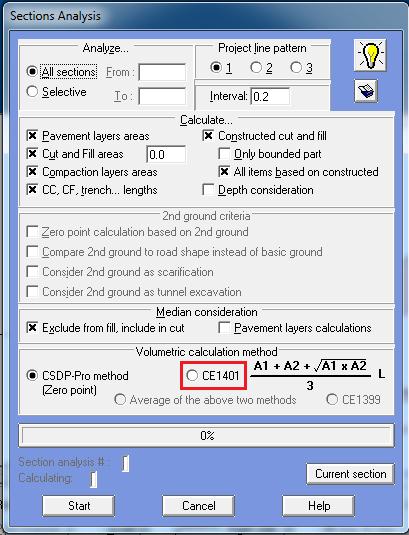
This feature has been included in the latest versions of the CSDP, CSDP+, and CSDP-Pro software. As shown in the figure opposite, during cross-section analysis, the user can select the CE1401 option to have the program apply the necessary corrections to the volumes.
|
|
|
|
However, this volume correction method itself causes discrepancies and inconsistencies in the calculated work volumes.
|
|
In general, the volumes and areas of Constructed Sections are required in the following cases:
- Completion of work by one contractor and commencement of work by another contractor
- As-Built Drawings
- Contractors' interim payment statements
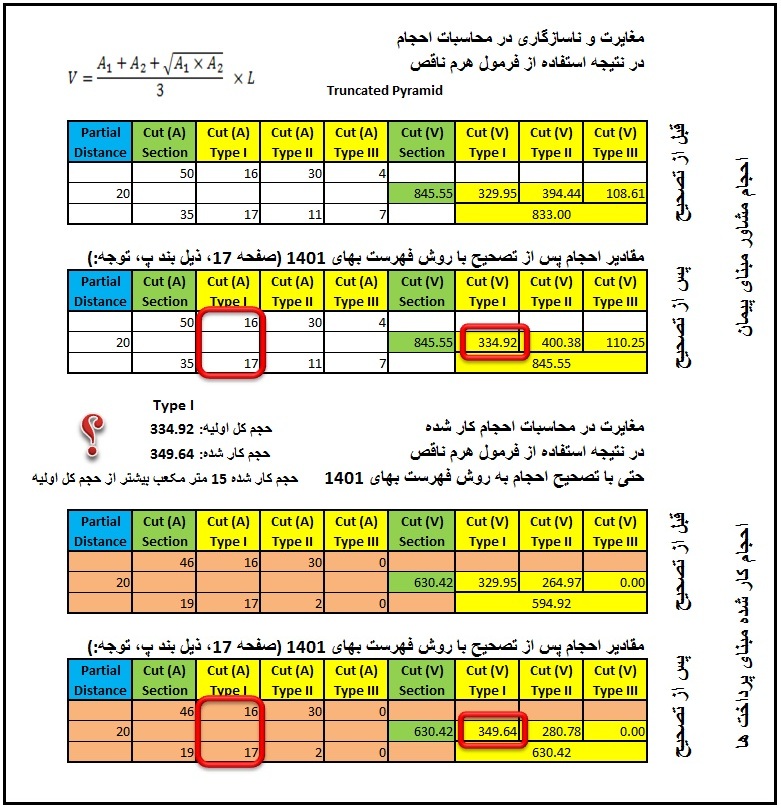
An example of this discrepancy and inconsistency is shown in the figure opposite.
As shown in the table above, the volume calculated using the Truncated Pyramid formula for Type I excavation between the two cross-sections is 329.95. After applying the correction method specified in the 1401 Price List, the resulting volume is 334.92.
The table below shows the calculation of constructed volumes for an interim payment statement.
It is assumed that, based on the shape of the constructed cross-section, Type I excavation has been completed, part of the Type II excavation has been carried out, and no Type III excavation has yet been performed.
In this case, the Type I excavation volume, after being calculated using the Truncated Pyramid formula and then corrected using the method specified in the 1401 Road Construction Cost-Estimate book, is 349.64. This is approximately 15 cubic meters greater than the original total volume of 334.92 calculated for the Type I excavation.
|
|
|
| Back to Top
|
|
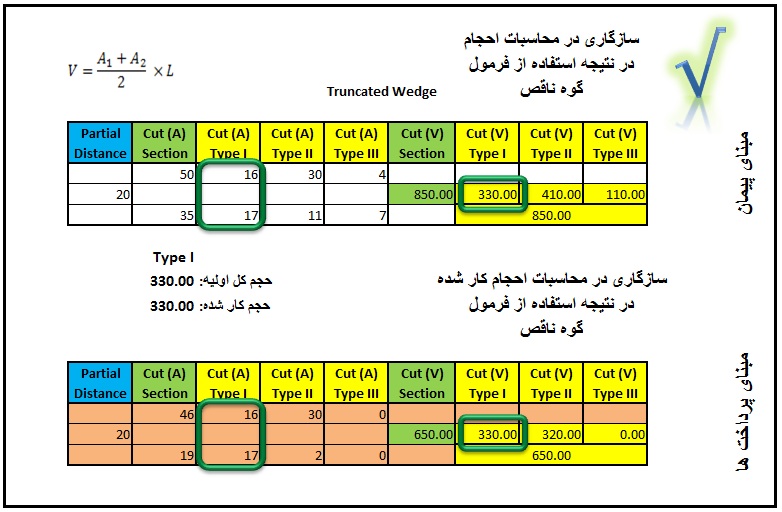
Unlike the Truncated Pyramid method, as shown in the figure opposite, the Truncated Wedge method, which is the standard formula for road construction volume calculations, does not create any discrepancy or inconsistency between the original total volumes and the constructed volumes.
In this case, using the same cross-sectional areas for the different soil classifications, for example Type I excavation, the volume is the same in both the original total volume and the constructed volume.
In general, the volume calculation between cross-sections depends only on the cross-sectional areas. Any correction or modification to the calculations results in discrepancies and inconsistencies in the volumes.
|
|
|
|
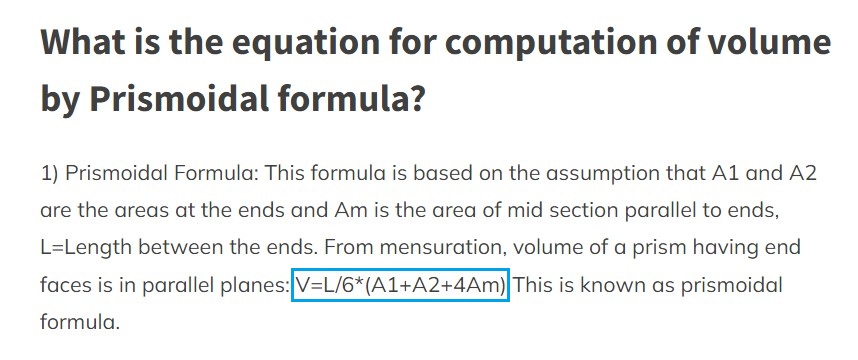
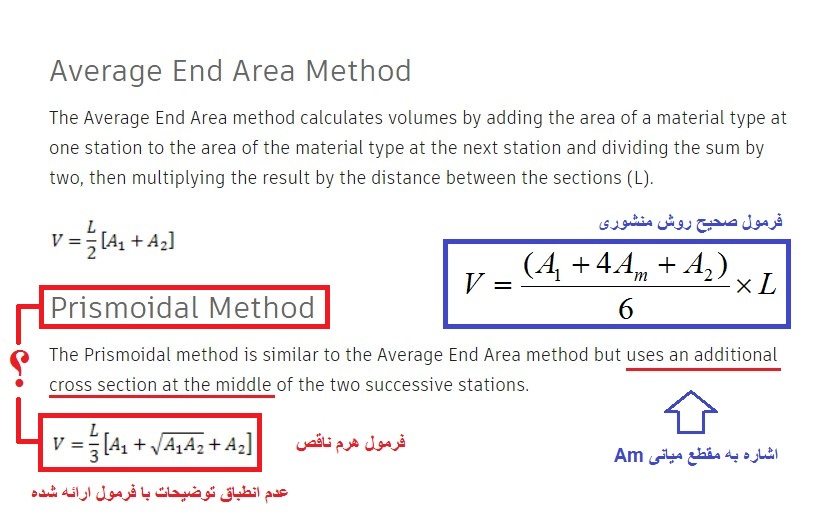
In all major road construction references, the prismoidal method for calculating volume is described using the formula V = L(A1 + 4Am + A2) / 6. In almost no reputable reference is the Truncated Pyramid formula mentioned as a method for prismoidal volume calculation.
In this regard, after reviewing the available references, only one software application was found to incorrectly present the Truncated Pyramid formula as the prismoidal method for volume calculation.
The figure opposite shows an excerpt from the relevant software documentation on the software's website.
As can be seen, the description of the Prismoidal Method specifically refers to the mid-section. However, the Truncated Pyramid formula is incorrectly provided below the description instead of the correct formula for the Prismoidal Method (blue box).
|
|
|
| Back to Top
|
|
Unlike the Truncated Pyramid method, the Truncated Wedge method, also known as the Average End Area Method, is the most widely accepted and reliable method for calculating road construction volumes worldwide, for the following three reasons:
1- It is very simple.
2- It is easy to check and verify compared to three-dimensional methods such as the Triangular Prisms method.
3- Most importantly, the most accurate method of volume calculation, which is integration, is fundamentally based on calculating the volume as the average of the two cross-sectional areas multiplied by the distance between the two cross-sections. The smaller this distance is, the more accurate the calculation becomes.
|
|
|
|
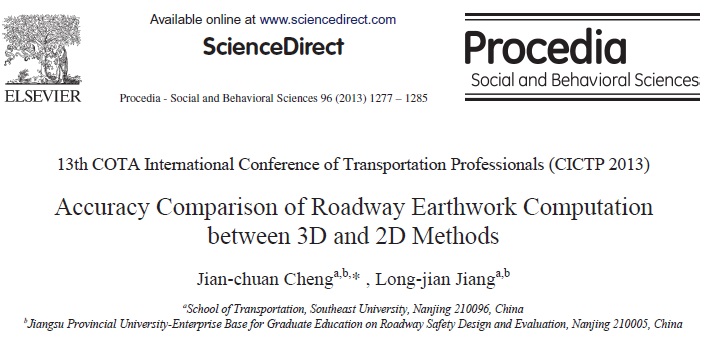
In this regard, studies have been conducted. As an example, the link and the related PDF file are provided below. Download
Based on these studies, it has been found that when the distance between cross-sections is 10 meters, the error using the Average End Area Method, compared with the three-dimensional method, is approximately 0.02%. In other words, for example, for 100,000 cubic meters of excavation, the error would be only 20 cubic meters.
Therefore, it is recommended to use the Truncated Wedge method, including the zero point (the program's default method), together with an appropriate distance between cross-sections.
|
|
|
|